German federal elections on Sunday will not only determine the future of Europe’s largest economy, but also the outlook for the whole continent as it grapples with existential questions, after the Trump administration made it clear that US security guarantees will not last “forever”.
Chancellor Olaf Scholz’s coalition government collapsed in November amid a fierce debate over how to deal with a shortfall of about €17bn in the 2025 budget, some of it linked to additional support for Ukraine in its battle against Russia’s invasion.
Friedrich Merz, leader of the centre-right Christian Democratic Union (CDU), is the frontrunner to become the next German leader. His party is leading in the polls and is poised to win about 30 per cent of the votes.
The far-right Alternative for Germany (AfD) — which is under investigation by the country’s intelligence service over potential anti-democratic tendencies — is on course to secure a record 20 per cent of the national vote. Scholz’s Social Democrats (SPD), who narrowly came first in 2021, are trailing in third place.
Options for forming the next German government may come down to how many of the three minor parties survive and how many votes go to fringe parties that will not be represented in parliament.
The liberal Free Democrats (FDP) and two far-left parties, Die Linke and the Sahra Wagenknecht Alliance (BSW), are fighting to secure the minimum 5 per cent of the vote needed to enter the Bundestag.
The more votes that go to parties not represented in parliament, the more seats the larger parties win per vote, making it easier for them to form a two-party coalition. If one or more of the smaller parties cling on to seats, a three-party coalition may be needed to form a government.
Sunday’s vote takes place as Germany grapples with the effects of shrinking economic activity for two straight years. Each party has pledged to drive economic recovery, while offering starkly different remedies for how to do so.
Immigration has also featured prominently in election campaigns after a string of fatal attacks by migrants. The AfD, which takes a hardline on immigration, has been buoyed by growing international support, including from X owner and key Trump adviser Elon Musk.
Who are the main parties and what are their key policies?
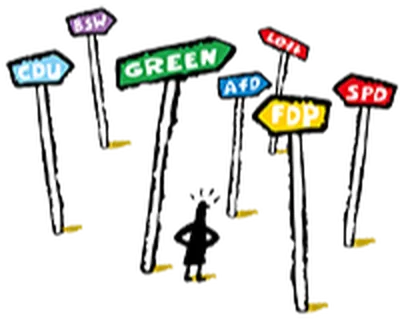
The declining popularity of Germany’s mainstream parties has fuelled the rise of the AfD, which will probably lead to a more antagonistic parliament.
The far-right party is expected to become the second-largest force in the Bundestag for the first time in the country’s postwar history. All other major parties have ruled out teaming up with the AfD — forming a so-called firewall that US vice-president JD Vance criticised last week at the Munich Security Conference.
Christian Democrats (CDU/CSU)
Merz’s Christian Democrats are in the strongest position heading into Sunday’s election, according to opinion polls. The party plans to cap corporate tax at 25 per cent, abolish an income tax surcharge for top earners and introduce permanent border controls.
Social Democratic party (SPD)
The SPD has pledged higher taxes on the wealthy, a minimum wage of €15 and a commitment to stable pensions. Last year, Scholz proposed a €100bn infrastructure investment fund to overhaul the country’s neglected infrastructure, including its struggling railways as part of a “new industrial agenda”. He has also called for a “Made in Germany” subsidy to incentivise corporate investment.
The Greens
The Greens have made sustainable investment a key policy of their campaign and are pushing for incentives to accelerate Germany’s transition away from fossil fuels. The party is also keen to ease the country’s debt brake as it has called for “sensible” changes to the rule.
Alternative for Germany (AfD)
Founded in 2013 in protest to the bailouts for Greece during the Eurozone crisis, the AfD has pivoted to the extreme right in recent years, prompting even Marine Le Pen’s Rassemblement National to shun the party.
Other parties
Three other parties could be crucial to the political landscape following Germany’s federal election if they secure enough votes to pass the minimum threshold of 5 per cent or to win three direct mandates.
Essential reading on the candidates and policies
POLL TRACKER: German election 2025: What are the main campaign pledges?
BIG READ: Can Friedrich Merz still fix Germany?
ANALYSIS: How Germany declined under Olaf Scholz — in charts
NEWS IN-DEPTH: Alice Weidel: the former Goldman analyst leading Germany’s far-right
NEWS IN-DEPTH: The hard-left Russophiles playing kingmakers in Germany
How does the election work?
After the past two elections resulted in bloated parliaments with more than 700 members, this will be the first time the number of MPs is capped at 630. Winners of the first-past-the-post constituency vote (Erststimme) are only elected if their party has gained a sufficient share of the proportional party vote (Zweitstimme) in their state.
Germany’s electoral system combines proportional representation and aspects of the first-past-the-post system, with 299 seats directly linked to local constituencies. The 5 per cent threshold is waived for any party that wins three of those direct mandates.
What happens after voting ends?
Preliminary results expected on Sunday night will be a good early indicator of the vote’s outcome.
Once the composition of the Bundestag is known, parties will enter coalition talks, which often last several months. Scholz’s government officially took office in December 2021 — two and a half months after the election.
The parties forming the next German government will need to unite behind a common platform, policy priorities and leadership structure. Disagreements over how to deal with shortfalls in the 2025 budget were the primary reason for the breakdown of Scholz’s government and it is unclear how a possible coalition between the CDU/CSU with the SPD and/or the Greens would overcome fiscal constraints.
Essential reading on German politics and history
Design by Carolina Vargas; data visualisation by Jonathan Vincent and Martin Stabe