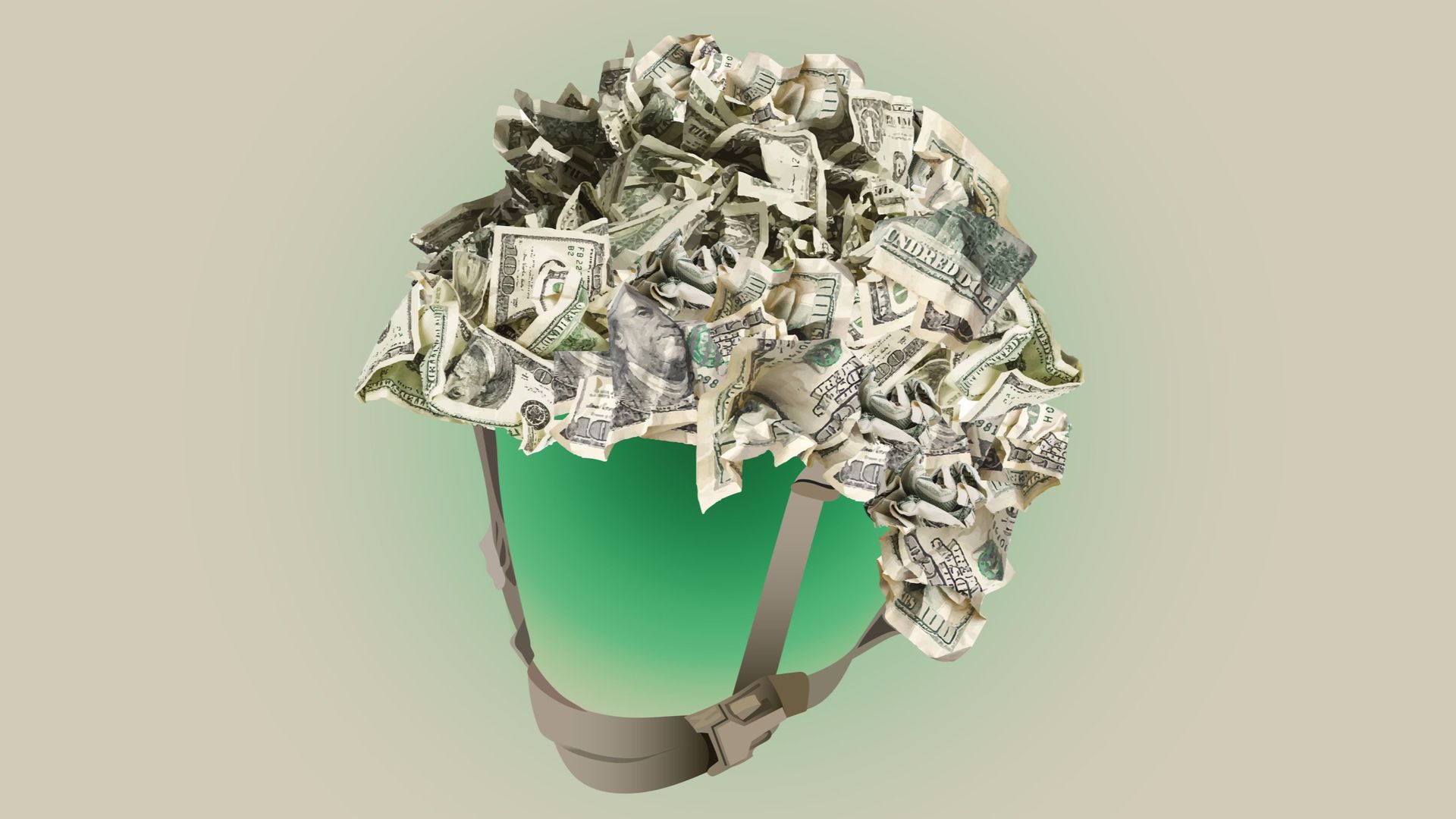
How did the word “capitalism” arise? If you ask most investors that question today, they might mutter about markets, commerce and Adam Smith — or Karl Marx. But according to Michael Sonenscher, a British historian, the term actually emerged first in 18th-century Europe in connection with war finance.
“‘Capitalism’ began as a French word (capitalisme) but was used initially to refer to several largely British problems,” Sonenscher notes. “The most salient was the [18th-century] system of war finance. In French, someone who lent money to a branch of the French royal government was called a capitalist (capitaliste).”
On one level, this is just an amusing quirk of history. But it should also prompt serious reflection today. In the decades after the cold war, the “peace dividend” was such that modern financiers — and voters — rarely pondered the question of how wars are paid for. This week, however, the Stockholm International Peace Research Institute reported that rising geopolitical conflict sparked a 7 per cent, inflation-adjusted, rise in defence spending last year, to a record $2.4tn, or 2.3 per cent of global economic output.
That partly reflects the impact of Russia’s invasion of Ukraine. Not only has American, European and Ukrainian expenditure jumped, but Russian military outlays have risen above 6 per cent of gross domestic product.
In fact, spending rose last year in all five geopolitical regions tracked by Sipri, for the first time. “States are prioritising military strength but they risk an action-reaction spiral in the increasingly volatile geopolitical and security landscape,” says Sipri researcher Nan Tian.
Rishi Sunak, UK prime minister, this week put Britain’s defence industry on a “war footing”, with expenditure slated to rise to 2.5 per cent of GDP by 2030, and Nato recently announced a $100bn spending plan. Then there are the $95bn worth of military aid bills for Ukraine, Taiwan and Israel that were just approved by the US Congress. The “action-reaction” spiral is under way.
Thankfully, this rate of increase is still lower than at various points in the 20th century — and it comes from a low base. Sixty years ago, before the peace dividend kicked in, the US and UK respectively spent 8 and 6 per cent of GDP on the military. But given that most modern investors built their careers when “capitalism” was defined in peaceful terms, there are at least three points they should note.
First, history shows that governments almost never tell voters the true cost of war, or how they intend to pay for it. Exceptions exist. In 1940, for example, John Maynard Keynes published a clear-headed pamphlet entitled How to Pay for the War. And last year Denmark cancelled a national holiday to create additional revenue for defence outlays. In the US, political consultants are supposed to scrutinise congressional spending bills. But transparency is rare. As Sonenscher notes, the key reason why 18th-century European kings issued debt to pay for military adventures was to circumvent the scrutiny of legislatures.
And while the recent furore around the Ukraine bill in Congress creates a veneer of democratic oversight, “public access to budget information about . . . post-9/11 [military spending] is imperfect and incomplete”, according to a critical report from Brown University’s Watson Institute.
The second lesson is that, even if costs are eventually wiped out via tax increases, inflation or plunder, there is usually a surge in debt. The Watson Institute estimates that in the US there has been $8tn in military outlay since 2001, which was “paid for almost entirely by borrowing”. Absent early repayment via massive tax rises, miraculous growth and/or default, “interest payments could total over $6.5tn by the 2050s”.
It is hard to believe that things in Europe will be any different. Yes, Sunak claimed this week that his mooted boost to military spending would be “fully funded”, via departmental spending cuts. But that sounds like magical thinking.
Third, the shock of war not only encourages heavy state economic intervention, but financial and technological innovation, too. In 1694, for instance, the British government embraced the idea of central banking to fund war. In the 1940s, the launch of American “war bonds” helped to launch a retail market for treasuries. The second world war also led to the British and American governments developing financial repression policies. Today, experiments are being mooted to securitise the proceeds of seized Russian assets for Ukraine.
Meanwhile, the US is outsourcing swaths of military tech innovation to venture capitalists. And I am told that asset managers are testing digital customisation techniques that will allow them to swiftly exclude hostile nations or regions from portfolios, while governments are unveiling new ways to track offending asset flows and assets.
Will such innovation will continue? Probably. But what is already clear is that without huge tax rises debt issuance will keep expanding if threats of war grow. That might be defensible geopolitical “insurance” for those states fearing attack. But it will almost certainly put upward pressure on interest rates. Modern “capitalists” — aka bond holder — should take note.